Two days that read like an operating thesis, not a trade show
Smart City Expo Santiago del Estero (SCESDE26) ran on May 20 and 21, 2026 at the Fórum Santiago del Estero, in its fourth consecutive edition. The Argentine chapter of the Smart City Expo World Congress — the Barcelona-rooted network that has expanded since 2011 to Brazil, Chile, Qatar, Japan, China, Mexico, Colombia, the United States and Argentina — is no longer the regional curiosity it was in 2022. It is now where the country's smart-city operating thesis is actually being argued.
The speaker list reads as the consolidated LATAM urban-policy bench: Gustavo Béliz, Secretario de Asuntos Estratégicos de la Nación; Pablo Javkin, Intendente de Rosario; Felipe Vera, Jefe de Operaciones para Argentina del BID; Romain Zivy, Director de la oficina argentina de CEPAL; Juan Corvalán, Director del Laboratorio de IA de la UBA; Verónica Baracat de ONU Mujeres; Maya Takagi de FAO Argentina; Andrés Ibarra de Fundación País Abierto y Digital; Roberto Converti de Oficina Urbana; Mauro Tamayo, Alcalde de Cerro Navia, Chile; Claudia Bocca y Leverci Silveira Filho, en representación de Curitiba y SESAN/MDS de Brasil; Diego Golombek, Fabio Quetglas, Micaela Sánchez Malcolm, Mario Pergolini. National, regional and international, in one programme.
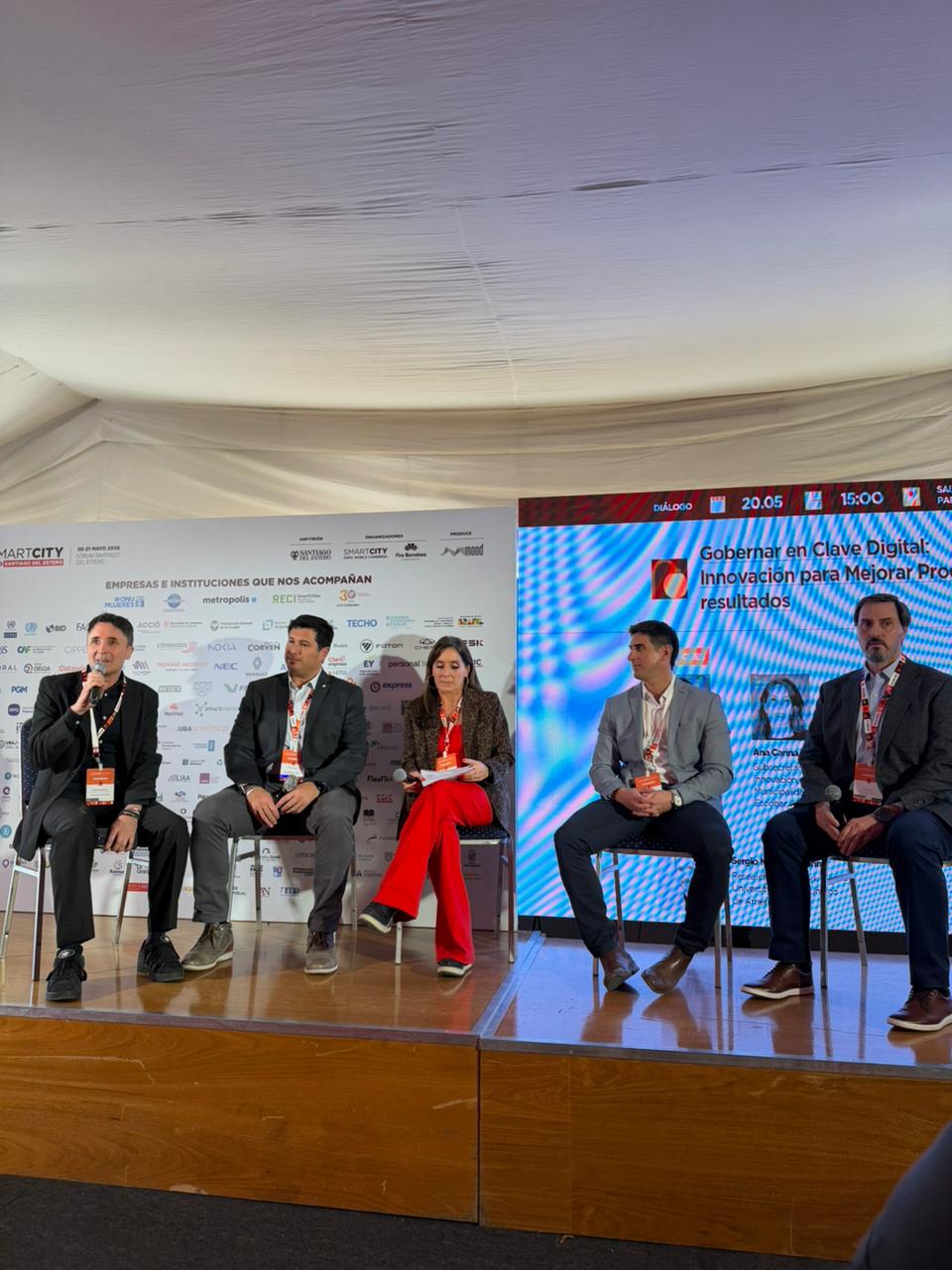
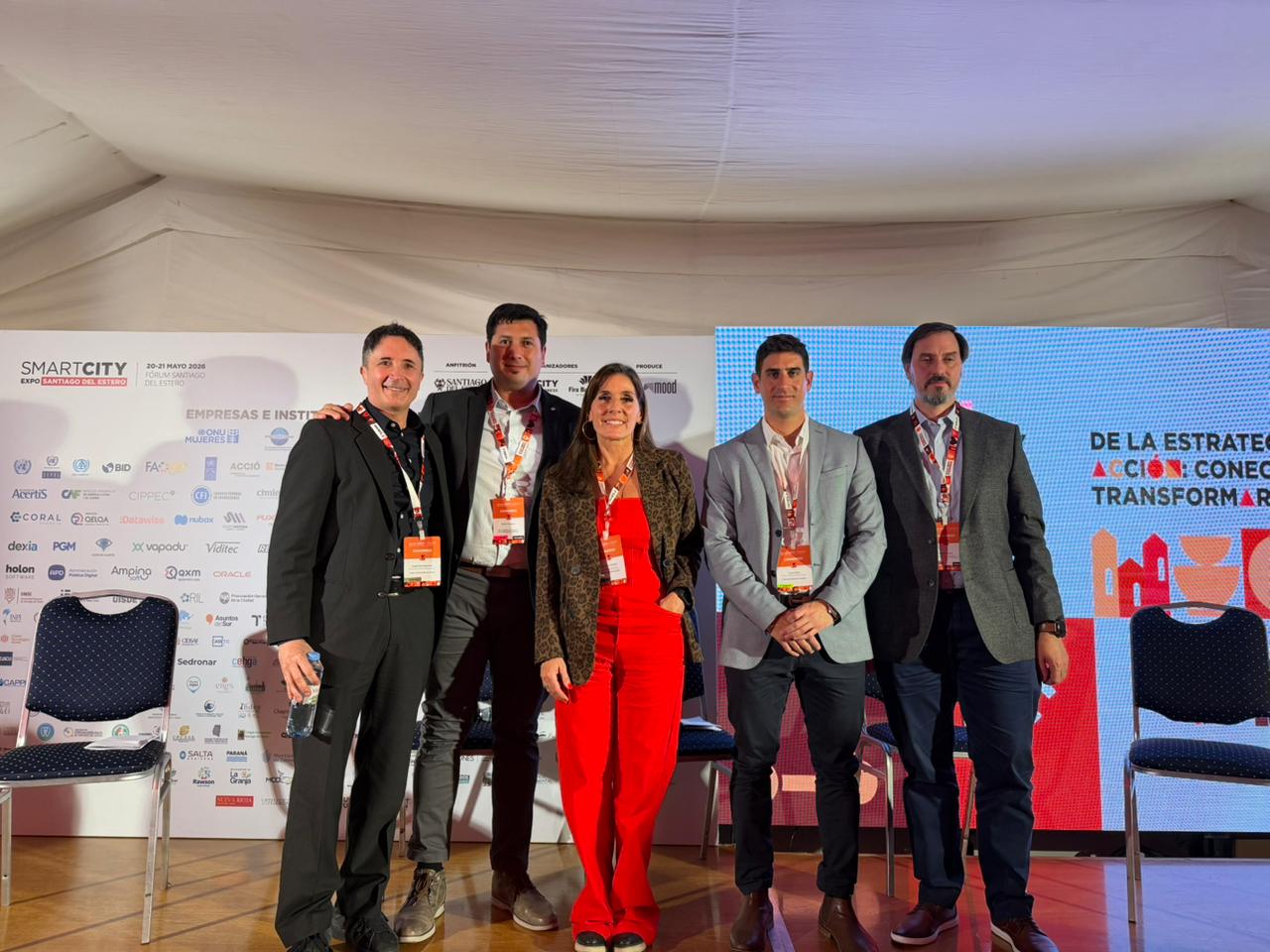
I had the privilege of moderating two sessions across the two days. The first, on in Sala Juan Felipe Ibarra, was titled "Gobernar en Clave Digital: Innovación para Mejorar Procesos y Resultados", with Hernán Contreras (RIL/CIIAR Argentina), Ana Carina Rodríguez (Municipalidad de Escobar), Lucas Mathé (Municipalidad de Córdoba) and Nicolás Ramos (EY) as panelists. A second moderated session, the following day, extended that conversation into the implementation territory. Both sessions converged on the same operating premise: institutional capability outranks technological choice.
In LATAM, the smart-city conversation has moved from aspiration to operating model. The expo proved it in two days.
The three layers of an urban operating model
The standard smart-city sales pitch still describes a stack: sensors at the bottom, dashboards in the middle, citizen apps on top. After two days of presentations and three rounds of cross-conversation, that framing reads as a category error. What the cities on stage were actually arguing about was a different stack — one that maps cleanly onto the operating-layer thesis this publication has been building.
Sensors, fibre, cameras, geospatial layers, mobility data, identity registries, AI models, payment rails. Real, cheap, increasingly interoperable. This is the layer everyone is selling. It is also the layer that, on its own, has the lowest correlation with citizen-felt outcomes.
Procurement rules that can absorb iterative work; cross-secretariat coordination that survives an electoral cycle; data governance that satisfies Ley 25.326; staff who can read a model card; a measurement function that publishes results. This is the slowest layer to build and the most contested layer on stage.
Time saved waiting in line. A streetlight that gets fixed in 48 hours instead of 14 days. A bus schedule that is actually accurate. A municipal trámite that closes in one visit instead of four. This is the layer that gets measured by re-election, by trust surveys, and by whether anyone shows up next year.
So what: the smart-city question is not "which technology" but "does the municipal operating model translate this technology into a measurable improvement in the citizen's day?" Substrate without institutional capability produces dashboards. Institutional capability without substrate produces meetings. The two together produce outcomes.
Three Argentine cities, three operating moves
Rosario · the integrated-service city. Intendente Pablo Javkin's argument from the main stage was that integration is the unit of citizen experience, not feature count. A single municipal identity layer that lets a resident move between health, transit, housing and tax services without re-authenticating is worth more than ten new apps. Rosario's measurement discipline — published service-level dashboards, public-procurement digital trail, open performance contracts with operating partners — is the kind of institutional capability the framework above is built on.
Córdoba · the digital-inclusion city. Lucas Mathé, Director General de Políticas Públicas de la Municipalidad de Córdoba and coordinator of Menos Brecha Más Comunidad, framed the argument inversely: technology adoption without digital inclusion produces a two-speed city. Córdoba's playbook combines high-impact trámites digitales (citizen-facing process digitalization) with a community-level inclusion programme that reaches the half of the population that does not own a current-generation device. The metric that matters is the share of citizens served end-to-end via the digital channel — not the share of services that have a digital option.
Escobar · the institutionalized-innovation city. Ana Carina Rodríguez, Subsecretaria de Innovación y CTO de la Municipalidad de Escobar, brought the operating-model argument to its sharpest form. Innovation is not a project, it is a permanent function with a budget line, a CTO, a roadmap and a measurement layer. Her 25+ years across Argentine digital-government posts — including national Subsecretaria de Innovación — produced the most quoted line of the panel: "redesign processes, not screens." Smart cities fail when they instrument bad processes with new interfaces. They succeed when the operating model is redesigned first and the technology supports it.
What every LATAM municipality should do this quarter
Three concrete moves dominated the cross-conversation rounds in the panel. They generalize cleanly to any LATAM city or municipality reading this debrief.
First, redesign the process before procuring the technology. Second, install a measurement function before installing the dashboard. Third, build the institutional capability — coordination, governance, data discipline — that lets the substrate compound.
So what: from pilot to policy. KPIs before APIs. Interoperability or it doesn't scale. The signature lines hold at the urban scale too — perhaps more sharply, because the citizen is in the room.
Governance
Map every citizen-facing AI-augmented decision to EU AI Act extraterritoriality, Ley 25.326 (Argentina), LGPD (Brazil) and Ley 21.719 (Chile). Place a human-in-the-loop checkpoint on every high-reversibility decision. Treat algorithmic transparency as a municipal SLA, not a research aspiration. Coordinate with national bodies (CIIAR Argentina, RIL, the IDB, CEPAL) instead of reinventing the policy in isolation.
KPIs
Six citizen-felt indicators a municipality can baseline this quarter: end-to-end-digital service ratio above 60%; mean time to resolve high-volume tickets below 72 hours; trámite-cycle compression of at least 40%; identity-attested action ratio at 100%; cross-secretariat data-sharing coverage of at least 50%; published trust-and-satisfaction score updated quarterly.
12-month roadmap
0–90: map citizen processes by volume × friction, baseline the six KPIs, audit data-sharing across secretariats. 90–180: redesign the top three high-volume processes and instrument them, sign cross-municipality peer-learning agreements (RIL / CIIAR), publish the first quarterly scorecard. 180–360: deploy AI augmentation on processes with measurable baselines only, light a sovereign-substrate fallback for sensitive workloads, report to the council quarterly on citizen-felt outcomes.
The smart-city argument is now an operating-model argument
The most useful thing about a four-edition expo is the longitudinal view. The 2022 conversation in Santiago del Estero was largely about "what is a smart city". The 2024 conversation was about "can we afford it". The 2026 conversation that just closed is about "how do we operate it well enough that the next administration cannot dismantle it". That is a healthier and harder question, and it is the right question to be asking right now.
Why smart cities, why now: because the polycrisis we covered last week — geoeconomic confrontation, supply-chain shock, energy volatility, AI-driven labor disruption — lands in cities. It lands in transit systems, in housing markets, in health networks, in public-procurement queues, in social-protection registries. The cities that have built an operating layer will absorb those shocks. The cities that have only bought the substrate will broadcast the damage in HD. Public capability is the variable, and it is built municipality by municipality, panel by panel, KPI by KPI. From pilot to policy.
Bring the framework to your city
Socradata runs Urban Operating-Layer Diagnostics for LATAM municipalities, secretariats and public-sector operators. The output is a citizen-process map, a six-KPI scorecard, a governance overlay and a thirty-day next-step list, ready for council review.